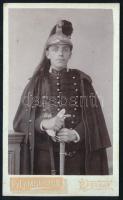
1915 A francia 17. gyalogezred (17e régiment d'infanterie) katonájának portréja, vizitkártya Lucien Brun (Aix-les-Bains, Savoie) műterméből, a verzón autográf sorokkal, 12x6,5 cm // 1915 Portrait of a soldier of the French 17th Infantry Regiment (17e régiment d'infanterie), cdv photo from the studio of Lucien Brun in Aix-les-Bains (Savoie), with autograph notes on the reverse, 12x6.5 cm
cca 1910 A francia 31. dragonyosezred (31e régiment de dragons) katonájának portréja, vizitkártya Ferdinand Lemercier (Épernay, Marne) műterméből, kis kopással, 10,5x6,5 cm // cca 1910 Portrait of a soldier of the French 31st Dragoon Regiment (31e régiment de dragons), cdv photo from the studio of Ferdinand Lemercier in Épernay (Marne), with slight wear, 10.5x6.5 cm
cca 1900-1910 A francia 17. gyalogezred (17e régiment d'infanterie) katonájának portréja, vizitkártya J. B. Haton (Rambervillers, Vosges) műterméből, 10,5x6 cm // cca 1900-1910 Portrait of a soldier of the French 17th Infantry Regiment (17e régiment d'infanterie), cdv photo from the studio of J. B. Haton in Rambervillers (Vosges), 10.5x6 cm
cca 1900 A francia 62. gyalogezred (62e régiment d'infanterie) katonájának portréja, vizitkártya P. Charles (Épinal, Vosges) műterméből, 10,5x6 cm // cca 1900 Portrait of a soldier of the French 62nd Infantry Regiment (62e régiment d'infanterie), cdv photo from the studio of P. Charles in Épinal (Vosges), 10.5x6 cm
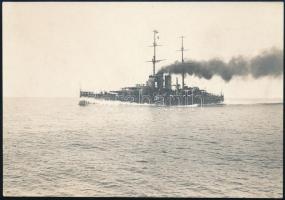
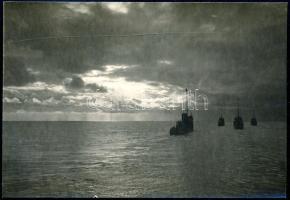
cca 1914-1918 SMS Tegetthoff, az Osztrák-Magyar Cs. és Kir. Haditengerészet (K. u. k. Kriegsmarine) Tegetthoff-osztályú dreadnought csatahajója, I. világháborús fotó, a hátoldalon feliratozva, jó állapotban, 14x10 cm. A trieszti Stabilimento Tecnico Triestino hajógyárban épült SMS Tegetthoffot az osztály második hajójaként, 1912-ben bocsátották vízre, egy évvel az SMS Viribus Unitis után; őt követte további két testvérhajója, az SMS Prinz Eugen és az SMS Szent István. A Tegetthoff-osztály hadihajói voltak az Osztrák-Magyar Haditengerészet első és egyetlen dreadnought csatahajói. Az SMS Tegetthoff 1913-as szolgálatba állítását követően 1915-ig a pólai hadikikötőnél állomásozott; harci cselekményben először Ancona kikötőjének bombázásakor vett részt, miután Olaszország hadat üzent az Osztrák-Magyar Monarchiának 1915. májusában. Ezt követően ismét távol maradt a háború eseményeitől, mivel az otrantói tengerzár meggátolta, hogy az Osztrák-Magyar Haditengerészet hajói elhagyják az Adriai-tengert. A Tegetthoff-osztály többi hajójával együtt jelen volt az otrantói tengerzáron megkísérelt áttörésnél 1918. júniusában, ahol az osztrák-magyar hadihajók egy olasz torpedócsónakok által végrehajtott rajtaütés miatt visszavonulásra kényszerültek. (Az SMS Tegetthoffot is támadás érte, azonban sikerült sértetlenül elmenekülnie; testvérhajója, az SMS Szent István viszont két torpedótalálat következtében elsüllyedt). A háború hátralevő részét Pólában töltötte, majd Olaszország birtokába került, a Monarchia ennek elkerülésére tett próbálkozásai ellenére. Az olaszok a hajót Velencébe szállították, ahol háborús trófeaként közszemlére tették; az 1920-as évek elején az ,,Eroi di nostri mari" (,,Tengereink hősei") című, az SMS Szent István elsüllyesztését bemutató filmben is szerepelt. A hajó végül lebontásra került La Speziánál 1924 és 1925 között. // cca 1914-1918 SMS Tegetthoff, Tegetthoff-class dreadnought battleship of the Austro-Hungarian Navy (K. u. k. Kriegsmarine), WWI photo, with description on the reverse, in good condition, 14x10 cm. Built at the Stabilimento Tecnico Triestino shipyard in Trieste, SMS Tegetthoff was launched as the second ship of her class in 1912, one year after SMS Viribus Unitis; she was followed by two other sister ships, SMS Prinz Eugen and SMS Szent István. The Tegetthoff-class warships were the first and only dreadnought battleships of the Austro-Hungarian Navy. After her commissioning in 1913, SMS Tegetthoff was stationed out of the Austro-Hungarian naval base at Pola (Pula) until 1915; she first saw combat during the Bombardment of Ancona following Italy's declaration of war on Austria-Hungary in May 1915. Afterwards, she saw no action for a while, due to the Otranto Barrage, which prohibited ships of the Austro-Hungarian Navy from leaving the Adriatic Sea. Along with the other Tegetthoff-class ships, she was present at the attempt to break through the Otranto Barrage in June 1918, where the Austro-Hungarian warships were forced to retreat as a result of an ambush carried out by Italian torpedo boats. (SMS Tegetthoff also came under attack, but managed to escape unharmed; her sister ship, SMS Szent István, on the other hand, was sunk by two torpedo hits.) She spent the rest of the war in Pola, then was handed over to Italy, despite the efforts of the Austro-Hungarian Monarchy to prevent it. The Italians moved the ship to Venice, where it was displayed as a war trophy; in the early 1920s, she also starred in the movie ,,Eroi di nostri mari" (,,Heroes of our Seas"), which depicted the sinking of SMS Szent István. The ship was finally scrapped at La Spezia between 1924 and 1925.
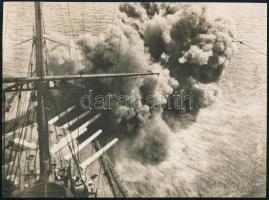
cca 1914-1918 Az elülső 30,5 cm-es ágyúk sortüze az Osztrák-Magyar Cs. és Kir. Haditengerészet (K. u. k. Kriegsmarine) egyik Tegetthoff-osztályú dreadnought csatahajóján, I. világháborús fotó, a hátoldalon feliratozva, jó állapotban, 16x11,5 cm. A Tegetthoff-osztály négy hadihajója (SMS Viribus Unitis, SMS Tegetthoff, SMS Prinz Eugen és SMS Szent István) az Osztrák-Magyar Haditengerészet egyedüli dreadnought csatahajóiként rendkívül korszerűnek számítottak, különösen tűzerő tekintetében. A hajók elsődleges fegyverzetét a négy lövegtoronyban hármasával elhelyezett 12 db 30,5 cm-es (305 mm-es) űrméretű, Škoda 30.5 cm L/45 K10 típusú löveg alkotta, melyeket 12 db (szintén Škoda gyártmányú) 15 cm-es ágyú, illetve további, kisebb kaliberű fegyverek, légvédelmi ágyúk és gépágyúk egészítettek ki. Mindezek mellett 4 db 533 mm-es torpedóvető csővel is fel voltak szerelve (egy-egy a hajó orrában, tatjában, és mindkét oldalán), melyekhez általában hajónként 12 torpedót tároltak. // cca 1914-1918 Salvo from the front 30.5 cm guns of a Tegetthoff-class dreadnought battleship of the Austro-Hungarian Navy (K. u. k. Kriegsmarine), WWI photo, with description on the reverse, in good condition, 16x11.5 cm. As the only dreadnought battleships of the Austro-Hungarian Navy, the four Tegetthoff-class warships (SMS Viribus Unitis, SMS Tegetthoff, SMS Prinz Eugen and SMS Szent István) were considered state-of-the-art, particularly in terms of firepower. The ships' main armament consisted of twelve Škoda 30.5 cm L/45 K10 guns mounted in four triple turrets, which were supplemented by twelve 15 cm guns (also manufactured by Škoda), as well as other smaller-caliber weapons, anti-aircraft guns and machine guns. Furthermore, each ship was fitted with four 533 mm torpedo tubes (one each in the bow, the stern, and both sides), for which they usually carried 12 torpedoes.
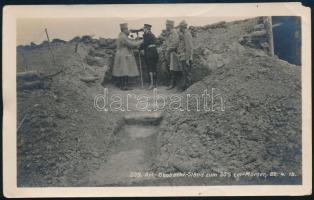
1915 Osztrák-magyar 30 és feles mozsár (Škoda 30.5 cm Mörser) tüzérségi megfigyelőállása a fronton, I. világháborús fotó, apró sarokhiánnyal, 9x14,5 cm // 1915 Austro-Hungarian 30.5 cm howitzer (Škoda 30.5 cm Mörser) artillery observation post on the front, WWI photo, minor corner damage, 9x14.5 cm
1915 Orosz tüzérségi megfigyelőállás a keleti fronton, körülötte osztrák-magyar katonák automobilokkal, I. világháborús fotó, 9x14 cm // 1915 Russian artillery observation post on the Eastern Front, surrounded by Austro-Hungarian soldiers with automobiles, WWI photo, 9x14 cm
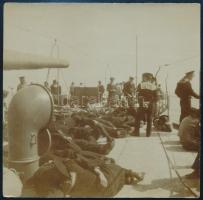
cca 1914-1918 Tengerészek egy osztrák-magyar hadihajó (feltehetőleg az SMS Satellit) fedélzetén, I. világháborús fotó, a hátoldalon feliratozva, 8,5x8,5 cm // cca 1914-1918 Sailors on the deck of an Austro-Hungarian battleship (possibly SMS Satellit), WWI photo, with description (in Hungarian) on the reverse, 8.5x8.5 cm
cca 1914-1918 Az Osztrák-Magyar Cs. és Kir. Dunaflottilla (K. u. k. Donauflottille) őrnaszádjai, I. világháborús fotó, a hátoldalon feliratozva, 11x7,5 cm // cca 1914-1918 Patrol boats of the Austro-Hungarian Danube Flotilla (K. u. k. Donauflottille), WWI photo, with decription on the reverse, 11x7.5 cm