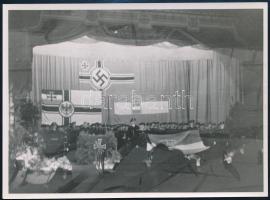
cca 1940 A III. Birodalom haditengerészete, mint az osztrák-magyar haditengerészet és a német császári haditengerészet szellemi örököse. Ünnepség a három zászlóval. Adolf Schmidt sorhajókapitány 17x12 cm / ca 1940. A large flag of the navy of the Third Reich tops the battle flags of the German Imperial Navy and the Austro-Hungarian k.u.k. Kriegsmarine in this ceremony being held on a theater stage. The man standing on the extreme left of the photograph appears to be k.u.k. Linienschiffskapitän Adolf Schmidt (born in 1871, gazetted Linienschiffsleutnant on May 1, 1898, and Linienschiffkapitän on May 1, 1915). 17.2 cm x 12.3 cm
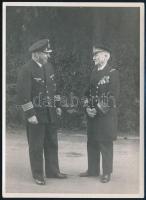
cca 1940 A III. Birodalom haditengerészetének, emlékünnepsége az osztrák-magyar haditengerészet és a német császári haditengerészetről, Adolf Schmidt sorhajókapitány és Helmuth Brinkmann (1895-1983) kapitány / ca 1940. Linienschiffskapitän Adolf Schmidt and Kapitän zur See Helmuth Brinkmann at the Tradition ceremonies of the Third Reich navy for the German Imperial Navy and the Austro-Hungarian k.u.k. Kriegsmarine 18x12,5 cm
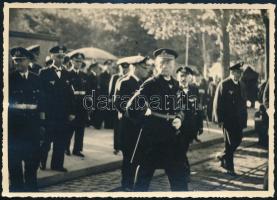
cca 1940 A III. Birodalom haditengerészetének, emlékünnepsége az osztrák-magyar haditengerészet és a német császári haditengerészetről, a távozó Adolf Schmidt sorhajókapitány és Helmuth Brinkmann (1895-1983) kapitány / ca 1940. Linienschiffskapitän Adolf Schmidt and Kapitän zur See Helmuth Brinkmann step out of the venue where the Tradition ceremonies of the Third Reich navy for the German Imperial Navy and the Austro-Hungarian k.u.k. Kriegsmarine 18x12,5 cm
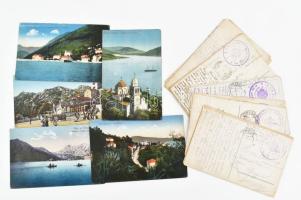
1916 Czakó Imre tüzér, a cs. és kir. 5. vártüzérezred (K. u. k. Festungsartillerieregiment No. 5) tagjának levelezése: a Kotori-öbölből és az Adriai-tenger partjáról családjának hazaküldött képes levelezőlapok (Kotor, Hercegnovi, Dubrovnik, Perasto, stb.), össz. 19 db, mindegyik az ezred bélyegzőjével ellátva
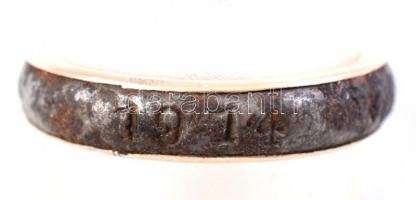
1914 Pro Patria 1914 gyűrű, arany(Au) belső résszel, méret: 57, bruttó: 3,8 g. Aranyat vasért mozgalom gyűrűje. A háború költségeire bizonyos mennyiségű aranyat ajánlott fel a lakosság, amiért cserébe egy "Pro Patria" gyűrűt kaptak, amit aztán büszkén viseltek.
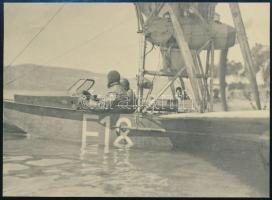
cca 1915 Osztrák-magyar haditengerészeti repülő Lohner LI-43a kikötőben, háttérben a 60T és 62T torpedócsónakokkal. A LI-43 egy Bari elleni támadásban motorhiba miatt leszállásra kényszerült, és legyénysége fogságba esett 7x5,5 cm / Autro Hungarian Navy plane L-43 on the water. Torpedo boats 60T and 62T are docked in the background. L-43 was one of the six Lohner L-type delivered to the k.u.k. Kriegsmarine in the spring and summer of 1915 (see L-42 above). After a raid on Bari on July 17, 1915, L-43 experienced engine failure and was forced to land. The crew, Fregattenleutnant Konstantin Maglić (born in 1891, gazetted Fregattenleutnant on May 1, 1913) and Fregattenleutnant Stephan Wollemann (born in 1893, gazetted Fregattenleutnant on August 1, 1914) were made prisoners of war but only after they set their flying boat on fire. Engine: 1 150 hp Rapp (push) (refitted) Span: 16.2 m; length: 10.85 m; maximum speed: 105 kmh; endurance: 7 hours; crew: 2 Armament: 1 8 mm machine gun for observer; 150 kg of bombs
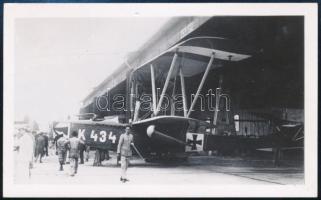
cca 1917 Osztrák-magyar haditengerészeti nehézbombázó melyet a Budapesti UFAG gyárban építettek 1918-ban. Malamoco bombázásában veszett oda 1918 augusztus 22-én. Három tagú legénysége fogságba került. Későbbi nagyítás12x7 cm / Heinkel W.13 KG-series long-range flying boat bomber. This machine was the most extensively used k.u.k. Kriegsmarine's flying boat during the last fifteen months of the war. Ernst Heinkel designed the W.13 around the Austro-Daimler engine. Flying boat K-434, shown in the photograph, was delivered on May 31, 1918 by Ufag of Budapest. It was the last of the K flying boats. It was shot down on August 22, 1918, during an attack on the Italian airbase at Malamoco; the three crewmembers were taken prisoner. Later copy. Engine: 1 345 hp Austro-Daimler (push) Span: 20.4 m; length: 13.2 m; maximum speed: 160 kmh; endurance: 6 hours; crew: 3 Armament: 1or 2 8 mm machine guns; 500-700 kg of bombs
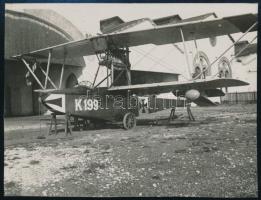
cca 1917 Osztrák-magyar haditengerészeti felderítő bombázó Weichmann K-199. 1917 februárjától decemberig szolgált, amikor landolás közben megsemmisült. 11x8 cm / Weichmann K-type flying boat reconnaissance bomber parked before a hangar. It is No. K-199; the photograph was taken from the front portside. No personnel is visible. By 1916, the Lohner L-series had been outclassed by Allied fighters and the k.u.k. Krigsmarine was looking for suitable replacements. Two firms built flying boats of almost identical design to meet Naval Aviation specifications and both were accepted. Oeffag's chief designer, Weichmann, produced 22 machines, some at Oeffag and others at Phönix. K-199 was built at Oeffag. It went into service on February 11, 1917, and was lost while attempting to land in Pola on December 8, 1917. Engine: 1 160 hp Austro-Daimler (push) Span: 16 m; length: 10.2 m; maximum speed: 135-140 kmh; endurance: 6 hours; crew: 2 Armament: 1 8mm Schwarzlose machine gun for observer; 150 kg of bombs
cca 1917 Osztrák-magyar haditengerészeti repülő E-18. Linienschiffleutnant Hugo Ockermüller vezetésével A repülő négy évig volt szolgálatban Montenegro ellen például, 1918-ban zuhant le / Linienschiffleutnant Hugo Ockermüller is seen here at the controls of E-18, a Type-M Lohner machine. With E-20 and E-21, she was part of the trio of flying boats that was sent to open the k.u.k. air station at Kumbor, in the Bocche di Cattaro. E-18 flew numerous bombing missions against Montenegro in the opening months of the war. Later she was transferred to Pola and Sebenico. She crashed on May 31, 1918, after being in service for over four years. Engine: 1 100 hp Gnome nine-cylinder rotary (push) Span: 13 m; length: 7.85 m; maximum speed: 98 kmh; endurance: 4 hours; crew: 2 Armament: 50 kg of bombs
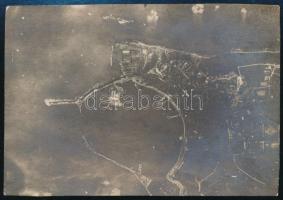
cca 1918 Osztrák-magyar haditengerészeti légi felderítő fotó Ancona kikötőjéről, ahol jól látszanak a hadi létesítmények, kézzel ráírt nevekkel beazonosítva 11x7,5 cm / Rare actual air-reconnaissance photograph showing the port of AnconaThe handwriting used to label port installations has faded, but the photograph itself is sharp and crystal clear . An invaluable historical document.
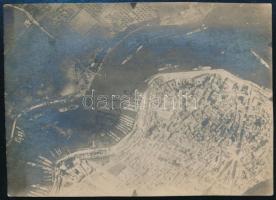
cca 1918 Osztrák-magyar haditengerészeti légi felderítő fotó Brindisi kikötőjéről, ahol jól látszanak a hajók, kézzel ráírt nevekkel beazonosítva12x8 cm / Rare actual air-reconnaissance photograph showing the port of Brindisi. Numerous warship are clearly visible and some identified by handwritten names or descriptions. Port facilities and army depots are also labeled. An invaluable historical document.
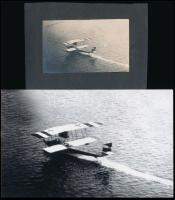
1918 Osztrák-magyar haditengerészeti duplafedelű repülőgép felszállásnál.. Feltehetően Lohner T típus. 7x4,25 cm / A k.u.k. Kriegsmarine two-seater flying boat taking off. Markings are not visible the machine is likely a Lohner T-type. 7x4,25 cm
Die Webseite von Darabanth GmbH nutzt Cookies, um Ihnen die bestmögliche Surferfahrung zu garantieren. Durch das Weitersurfen auf dieser Webseite stimmen Sie der Verwendung der Cookies automatisch zu.